

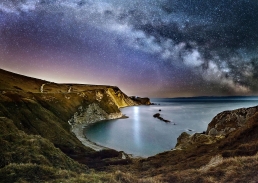
Surrender At The Footsteps Of God
he night started off at 2am, waking up and getting out of bed not long after I had gotten in. I looked out the window and the sky was coated with low hanging, thick cloud. I got back into bed, I lay there a moment. The weather forecast had been for clear, beautiful skies over Durdle Door - my eyes argued the opposite. Eventually, against my better judgement, I got out of bed and headed for the coast.
When shooting the Milky Way (and I am no expert from a photography sense) you need to first let your eyes adapt to the darkness. Once you have been in complete darkness for a around 20 minutes, when you look in the direction of our galactic core, you can slowly start to see the dust and clouds that form the band you see in the image above. As for taking the image, I find that shooting with a large aperture lens, such as an F/1.4 is best and setting your ISO no higher than 3200.
The shot you see above is a panorama of the serial arm of the Milky Way galaxy that we can see from earth. It contains approximately 250 billion stars and is 150 billion light years in diameter. The means that to travel from one side of it to the other, it would take you 150 billion years travelling at 671 million miles per hour. Yeah, its pretty big. What you are looking at is one part of a serial arm.
Anyway, it was freezing at Durdle Door this morning, I mean really freezing. I lasted there until about 5.30am, when we realised it wasn't going to be the best sunset and I packed up and headed for McDonalds.
