

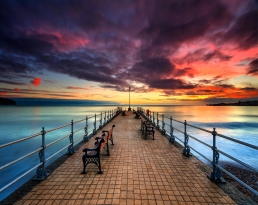
The Sky Explodes Over Swanage Jetty
hen I first opened my eyes this morning, at around 5.15am, I wondered if it was even worth going out. The weather forecasts as for clear blue skies, with no cloud whatsoever and the view from my bedroom window did little to disprove that. But having thrown a coffee down my throat, I decided that nothing ventured, nothing gained.
So I headed towards Swanage. By the time I passed through Corfe, the skies were doing little to impress me but I could see a glimmer of pre-sun in the distance so I decided to carry on. By the time I arrived at the old pier (which was shut), the sky had began to turn a little red and I quickly raced over to the jetty to see if I could capture something a little dramatic. This is what I saw.
Shortly after taking this image, I met a fellow photographer named Mark. We talked, as most photographers do, about everything we dislike about our chosen passion. Those kinds of photographers who do it simply to sell their work, or those that take image after image from the same place. We talked about how few people seem to still do it for the love of taking images, as so many seem to be doing it simply to earn a few quid, be it by selling their work or offering tuition. Still, we are definitely the same kind of photographer.

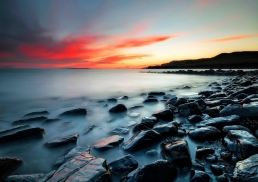
Between The Sand & Stone
o watch it slowly fall beneath the horizon and to watch the break taking colours that change from moment to moment is nothing short of wondrous. It is at sunset that the colour turns, when the sky can move from white to yellow to orange to red, in the time it takes to fire off an exposure of each. Some would argue that sunrise is better, but I find the light in the early morning to be harsh and cool at that time of day. For me, sunset is the ultimate experience.
I have also recently discovered that I am a hypocrite. Not long ago I chastised other 'photographers' for doing nothing but take 'iconic' images of famous landmarks. As I stated in a recent post, they take images from the same place, every single time; as if their camera won't accept any composition that may not have been done to death already. And lately, for the last week or so, I have found myself doing little else. I have shot iconic images wherever I have gone. What what I also notice, and I noticed this at Kimmeridge last night, was that other photographers seem to never move from spot. Although I took all of my images from roughly the same place, I moved position about 6 times in order to fine tune my composition and garner a slightly different feel to each image. The pair of photographers besides me did not move once. They set up their tripods when they got there and they never moved them until it was time to get home. Is this due to the fact that they have found the perfect combination, is it laziness, or is it a lack of creativity? I honestly do not know.
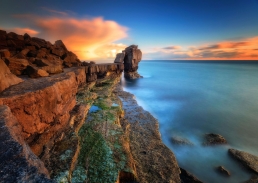
The Lonely Path To Pulpit Rock
nd I mean that as a huge compliment. Whilst spending an hour down at Pulpit Rock, I was joined by a photographer from that part of the world who simply wasn't content with the shot I managed to get and decided to climb down into the sea and get some shots from really low down. In the end, it cost him his Big Stopper. No, that is not a euphemism, it is the nickname for a 10-stop Lee Filter. Anyway, I think his name was Eric, the wind was so strong and loud that I could barely hear what he was saying. But I was jealous that he had managed to climb down the rock face and that he was brave enough to stand practically in the sea whilst taking his images. I thought I was a risk taker when it came to getting in the right place for the shot, standing on crumbling ledges and on the edges of cliffs - but 'Eric' took the word crazy to an entirely new level :).
I left before he did...I hope he managed to climb back up ok!
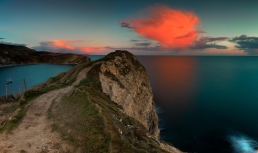
Sunset Down At Lulworth
unrise at this time of year is before 6am and in order to be in position for when the soft light appears, you really need to be arriving on location no later than 5.30am. So I found myself, at this ungodly hour, standing on the edge of the sea with nothing for company but the sound of waking waves. The tide was coming in and as I positioned my tripod right by the edge of the sea, I kept one eye on the light and one fixed firmly on the ever-nearing tide.
I wanted to get something low down, giving the images a sense of power and of the sheer size of the bay. Another benefit of positioning your camera low to the ground is that you make the foreground that little more apparent. No one normally looks at what is right before the camera, preferring to let their eye be guided into the frame and led towards the point of focus. But when the camera is positioned low, these little stones become a little more obvious. That was what I wanted, a contrast between the sea and the stone, a wave/particle duality if you will.
I also decided to shoot most of my stuff today in long exposure. For me, long exposure is great at isolating that which doesn't move. The fact that everything moving is given a softness, everything that doesn't, by comparison, is given a stronger appearance. This leads to an overall contrast boost and gives static edges a little more grandeur.
I spent a good two hours at Durdle Door this morning, and apart from another pair of photographers and their little dog, I saw no one all morning. Photography is a lonely passion, it is supposed to be. It is a path best trod in solitude.
The Grass Is Always Greener
unrise at this time of year is before 6am and in order to be in position for when the soft light appears, you really need to be arriving on location no later than 5.30am. So I found myself, at this ungodly hour, standing on the edge of the sea with nothing for company but the sound of waking waves. The tide was coming in and as I positioned my tripod right by the edge of the sea, I kept one eye on the light and one fixed firmly on the ever-nearing tide.
I wanted to get something low down, giving the images a sense of power and of the sheer size of the bay. Another benefit of positioning your camera low to the ground is that you make the foreground that little more apparent. No one normally looks at what is right before the camera, preferring to let their eye be guided into the frame and led towards the point of focus. But when the camera is positioned low, these little stones become a little more obvious. That was what I wanted, a contrast between the sea and the stone, a wave/particle duality if you will.
I also decided to shoot most of my stuff today in long exposure. For me, long exposure is great at isolating that which doesn't move. The fact that everything moving is given a softness, everything that doesn't, by comparison, is given a stronger appearance. This leads to an overall contrast boost and gives static edges a little more grandeur.
I spent a good two hours at Durdle Door this morning, and apart from another pair of photographers and their little dog, I saw no one all morning. Photography is a lonely passion, it is supposed to be. It is a path best trod in solitude.
A Dying Sun
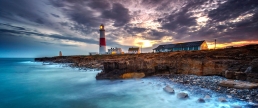
ep, that is exactly what I did last night and whilst the weather inland was quite warm and calm, the situation at Portland was very different. The winds roared, the sea swelled and as I stood on the edge of the country, I could feel the full force of God's breath. It was freezing, but I was determined to get some decent shots.
And I think I did. I don't normally like going to the same place on consecutive trips, but everywhere else had a forecast for bright blue skies and Portland was the only place that was reported to have any cloud cover. As I am sure you are all aware, there is nothing worse for a photographer than bright, featureless skies. So, I headed to Portland, minus my coat. Anyway, I started off over the far side of the lighthouse with the colour in the sky behind me. I thought to myself that I would slowly make my way from there to the far side of the lighthouse where I would then capture the setting sun. Although the sunset wasn't the best I have ever seen, I have certainly witnessed a lot worse. There was a hint of orange, magenta and red in this dying sun and as it mades it way beneath a distant horizon, it bled into the nearby clouds. The problem is that at this time of year, the sun sets way over to the right and it is almost impossible to get it into shot at Portland. So, I decided to do a few panoramas. Six shots, with an incredibly close focus point to give the image a sense of immediacy. As I fired off shot after shot, all 6 seconds long, I watched a pair of seagulls fighting in the sea. Locked in battle, they bobbed upon the roaring tide, wings flapping and beaks snapping. Eventually, just as I finished my panorama, the angry sea carried them into the rocks and out of sight. For a moment I was worried, worried that the sheer weight of the swell would have killed them as it knocked them into the coast. But a few moments later my fears were quashed and I watched them both fly off towards the lighthouse for round two. The image, I think, was a success.
A Rare, Red Sunset Over Durdle Door
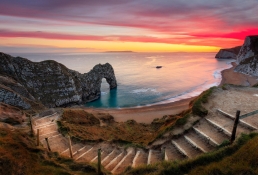
he weather on this little part of the coast can be completely different to how it is just a mile or so inland. But the skies looked promising as I made the drive down to the coast and I was sure that when I got there, there might be something worth photographing.
What I did find when I arrived was that the place was absolutely deserted. Durdle Door at sunset is usually littered with photographers, all standing in the same place to get the same shot and it makes life difficult for those of us who want to get a shot of something other than a close up of the 'door'. Seriously, they all stand in the same place, like lemmings, all trying to get that one shot. Sometimes I just watch them, all standing there and never moving to get a different composition. Some of them can be there for hours. Still, on this occasion, the place was empty.
That was until Kevin started to make his way down the hill. I didn't know Kevin at the time, but we got chatting and he seemed like a really nice guy. From North Wales, near Snowdon in fact, he had ventured down here for a training course and decided to photograph some of the local places whilst here. How I could have done with him when I was up in Snowdon a week or so back...
The Mighty Cove
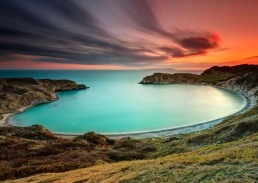
he place was heaving, like I have never seen it before. Waiting for my friend to eventually turn up, I waited in the car and watched the throngs of tourists mill around, shouting at their kids and arguing with their partners. I hoped that as sunset approached, these people would slowly start to leave. Thankfully, they did.
But the time my friend arrived, the place was still busy and we decided to shelter from the crowds in the local pub. The sky was a little insipid and lacked anything in the way of colour, with white light hovering over the cove. We were certain that once again, this visit was not going to pay off. Eventually, after a pint of lager and something to eat, we checked our watches and decided to make the long walk around the cove and up the massive hill. And trust me, this is a hard walk. Firstly, you have to trudge your way around the waters edge, sinking into shingle and pebbles with every step. He had stated that he thought the sunset was going to be awesome, but I didn't believe him. By the time we reached the foot of the staircase up the hill, the sky was still without a story. Then we read the sign. "No access due to landslide." Dorset is always suffering landslides and we didn't pay it any further noticed as we climbed over the sign attached to the bench and made our way up the never-ending steps.
By the time we reached our position, way up above Lulworth Cove, the sky was in fact starting to come alive. There really is only one composition from up there and I angled myself where I could just about pick up the entire cove and the little bit of colour being squeezed out of the dying sun in the corner of the frame. For the briefest of moments, it turned blood orange and I shouted for him to make his way down the hill to join me. Slipping and sliding, he eventually made it down to where I was and set up for a shot next to me. This is my result.
The Hidden Cove
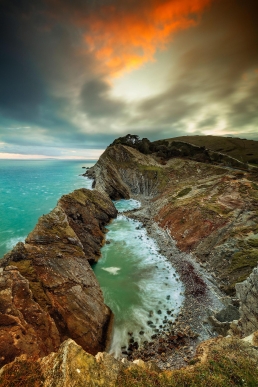
owever, due to a very high tide, I was unable to make the trip around the bay and up the hill to get a shot of the actual cove. So, instead, I decided to concentrate on the hidden little inlet that sits just west of the cove itself. The sunset was promising, with a little bit of colour in the sky and fast moving clouds. So I set up on the edge of a precarious ledge, just south of the sign that read "do not pass this point, unstable ledge." Well, I probably shouldn't have gotten so close to the edge, but it was the only way to get the shot.
Trouble is, it is very hard to get a nailed on composition of this part of Lulworth. It is almost impossible to capture in landscape format, so I chose portrait instead. Shooting at 16mm in landscape mode, you still cannot fit the entire scene in and the sky gets cropped way too tightly. In portrait mode, it is a little better.
Anyway, the sunset wasn't quite as good as I had hoped, but there was still some nice colour in the sky. I managed to capture a little bit of movement in the water and all in all, I find it to be quite a nice composition. Hopefully going back there today to finish what I started.
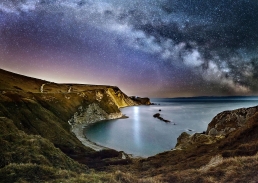
Surrender At The Footsteps Of God
he night started off at 2am, waking up and getting out of bed not long after I had gotten in. I looked out the window and the sky was coated with low hanging, thick cloud. I got back into bed, I lay there a moment. The weather forecast had been for clear, beautiful skies over Durdle Door - my eyes argued the opposite. Eventually, against my better judgement, I got out of bed and headed for the coast.
When shooting the Milky Way (and I am no expert from a photography sense) you need to first let your eyes adapt to the darkness. Once you have been in complete darkness for a around 20 minutes, when you look in the direction of our galactic core, you can slowly start to see the dust and clouds that form the band you see in the image above. As for taking the image, I find that shooting with a large aperture lens, such as an F/1.4 is best and setting your ISO no higher than 3200.
The shot you see above is a panorama of the serial arm of the Milky Way galaxy that we can see from earth. It contains approximately 250 billion stars and is 150 billion light years in diameter. The means that to travel from one side of it to the other, it would take you 150 billion years travelling at 671 million miles per hour. Yeah, its pretty big. What you are looking at is one part of a serial arm.
Anyway, it was freezing at Durdle Door this morning, I mean really freezing. I lasted there until about 5.30am, when we realised it wasn't going to be the best sunset and I packed up and headed for McDonalds.